Showing posts with label Exhibition Reviews. Show all posts

Saturday, 26 August 2017

High Days and Holidays at Totnes Fashion and Textile Museum Review

Totnes Fashion and Textile Museum’s annual exhibition this year focuses on holiday and leisure wear from the Edwardian period to the present day. As always the exhibition showcases a variety of objects in their archive whilst sticking to a central theme. The museum has three large cases which section the exhibition into three parts: travel wear, beach and leisure wear and evening and entertainment. 


The first case looks at travel wear, with garments ranging from the Victorian through to the 1970’s. The accompanying text discusses how clothes for travel changed over the years; from more formal dress, to that which is comfortable for long journeys. Outfits were chosen to reflect the changes in transport for travelling to holidays, for example the growing popularity of the motorcar in the 20’s, which saw a shift to looser fashions. I particularly liked the outfit for this period (pictured) the navy coat clearly of middle -eastern influence, the caption in the catalogue informs us the embroidery could have been Palestinian and bought on a previous holiday abroad. There was also an example of a holiday outfit worn in the time of utility, the dress and coat would have required clothing coupons to buy them. 
Dress for Travel through the Ages
Detail of Possible Palestinian Embroidery on a 1920's coat
Close up of 1940's Utility Coat and Dress
The second case, much larger was split into two halves; the first, clothes worn for leisure while on holidays, exploring the changing styles of beach and swimwear. While the far end of the case showcased pieces for evening events and parties. There were several good examples of 50’s day wear; including a Horrockses dress and c.1954 four piece set of skirt, boned strapless top and jacket/shirt in printed cotton in cool floral colours. I could imagine it being worn by a young woman on a day trip to the seaside. Layed out on the floor were examples of swimwear through the ages; from an 1885 bathing suit to more retro examples from the 50’s including a floral fitted top and knicker combo and modern pieces. Other outfits showcased in this section included Tennis dresses from 1933 and 1905, promenade and tea dresses. 
1950's Cotton Horrockses Dress and Floral Suit
Close up of the dress and Jacket of a 1950's Floral Suit. Very chic and modern.
1950's Peplum Bathing Top and Knickers
1885 Bathing Suit
In the other half of the case were some stunning examples of evening glamour and in turn evidence that dressing for dinner was a much bigger affair in the past. Two standout pieces are an 1878 gown with a sumptuous bustle, clearly a piece to show her status, with its intricate details of pleating and ruffles. The catalogue informs us this level of detail in dress became more popular at this time due to greater access to sewing machines. The other stand out piece for me was a bronze silk satin 1910 dress in the style of those by Paul Poiret. The waist is so tiny; it’s amazing to think how small people were over 100 years ago. Another beautiful outfit was a 1925 ensemble intended for going out to dinner. The sparkling lime green dress and plush fur coat projecting notions of wealth and luxury, she was clearly an important lady of society! In comparison to these pieces though, the examples of modern dinner dress are nowhere near as flamboyant: represented in 90’s formal evening and early 2000’s cruise wear. Like in the 20’s modern styles still have a sparkle but are much more casual silhouettes, with loose smocks, blouses, skirts and jackets.
1911 Paul Poiret Style Bronze Dress
Detail of Paul Poiret Style Dress
1878 Gown with pleated bustle. Background examples of 1990's cruise wear
1925 Opera Ensemble with fur coat and lime green beaded dress
The third case is devoted to clothes suitable for entertaining; be that afternoon tea, a dinner party, or formal soiree. Particularly standout pieces were an 1840’s cotton dress, usually worn at a dinner with friends. The pleating on the v shaped neckline was exquisitely precise along with the pipped waist seam and cartridge pleating. Perhaps the most understated piece in the case, it stands out for its technical details. 
Exquisite Pleating on an 1840's cotton tea dress
In contrast there are plenty of luxurious beaded creations: including a splendid 20’s cocktail dress with gold satiny shawl, oozing sensual decadence its rich colours evocative of the Art Deco art movement. While another has a royal connection; a black velvet and sequin gown (c.1900) worn by Marie Corelli, the Price of Wales (Edward VII) favourite author. One of my favourites was a simple blue and white polka dot nylon dress worn with a white fur jacket, the nylon fabric would have made it easier to pack as it doesn’t crease easily. The link between travel and clothes is again demonstrated in this final case of clothes worn for the most important occasions, in turn tying the whole exhibition together. This was communicated rather innovatively in the last object in the exhibition. A gold and cream 1886 dress constructed in two parts of bodice and skirt a new invention at the time which made it easier to pack a lady’s dresses and would then be worn at a country house dinner. It showcased how fashion for festivities has always been designed with frivolity and function in mind.  
1920's Art Deco style Cocktail Dress
Evening Dress worn by Marie Corelli (c.1900)
Blue nylon Polka Dot dress with fur jacket
1886 Country House evening dress with separate bodice and skirt
To conclude a clever exhibition that showcases some lovely examples of fashions through the ages from high fashion to the everyday and in turn through the sartorial depictions reflects how travel, tastes and activities have changed and developed alongside.  


References:

Fox, J., Totnes Fashion and Textile Museum 2017. High Days and Holidays. 16th May - 29th September  2017. Totnes: Totnes Fashion ad Textile Museum.


Diana – Her Fashion Story Review

Diana, Her Fashion Story chronicles the role of the late princess exploring her development from shy debutante to a confidant woman, who used her status to bring attention to taboo social issues and in many ways shaped the modern monarchy.  

The first room centers on her clothes in the early years of her marriage and engagement; the shy romantic Diana who loved frills and ruffles. A dress designed by Regamus for a Ball at Althorp House is the first dress you see as you enter the exhibition, the starting point of her journey. Also in the cabinet is the pink dress Diana wore for her official portrait in 1987 again promoting her fairy tale 1980’s princess aesthetic with the full skirt, princess line bodice and chic wrap around collar. Contrasted against these two pieces are a couple of her later dresses including a white pleated almost Grecian style dress she wore to a ballet in Rio de Janerio in 91’ . The development in style is apparent, the later dresses being much more fitted over her hips and more sophisticatedly elegant in pale greys, creams and soft silk organza in contrast to the crisp silk taffeta and tulle net of her early marriage. 
Reagamus Dress
Official Portrait Dress
Rio Ballet 91' Dress

That isn’t to say the princess couldn’t also be dramatic in her dress sense the next room bought your attention to her love of the arts and theatre in particular. Set in the cabinet with complementary scenery as if to evoke a theatre stage, were two of her theatrically inspired dresses. One of my personal favourite garments on display was a copy of a striking flamenco inspired dress Diana wore to a ball in Spain (with one black and one red glove).


The dress had an unusual finish on the hem; with the net skirt appearing to be edged with black binding. I particularly loved the theatricality of this piece it felt quite fun and dramatic, intended to get people talking. 
That’s something I felt strongly walking through the exhibition; Diana knew how to use clothes to make a statement particularly as she grew into her role of a royal she started to create a language through her clothes, always striking the right note. 

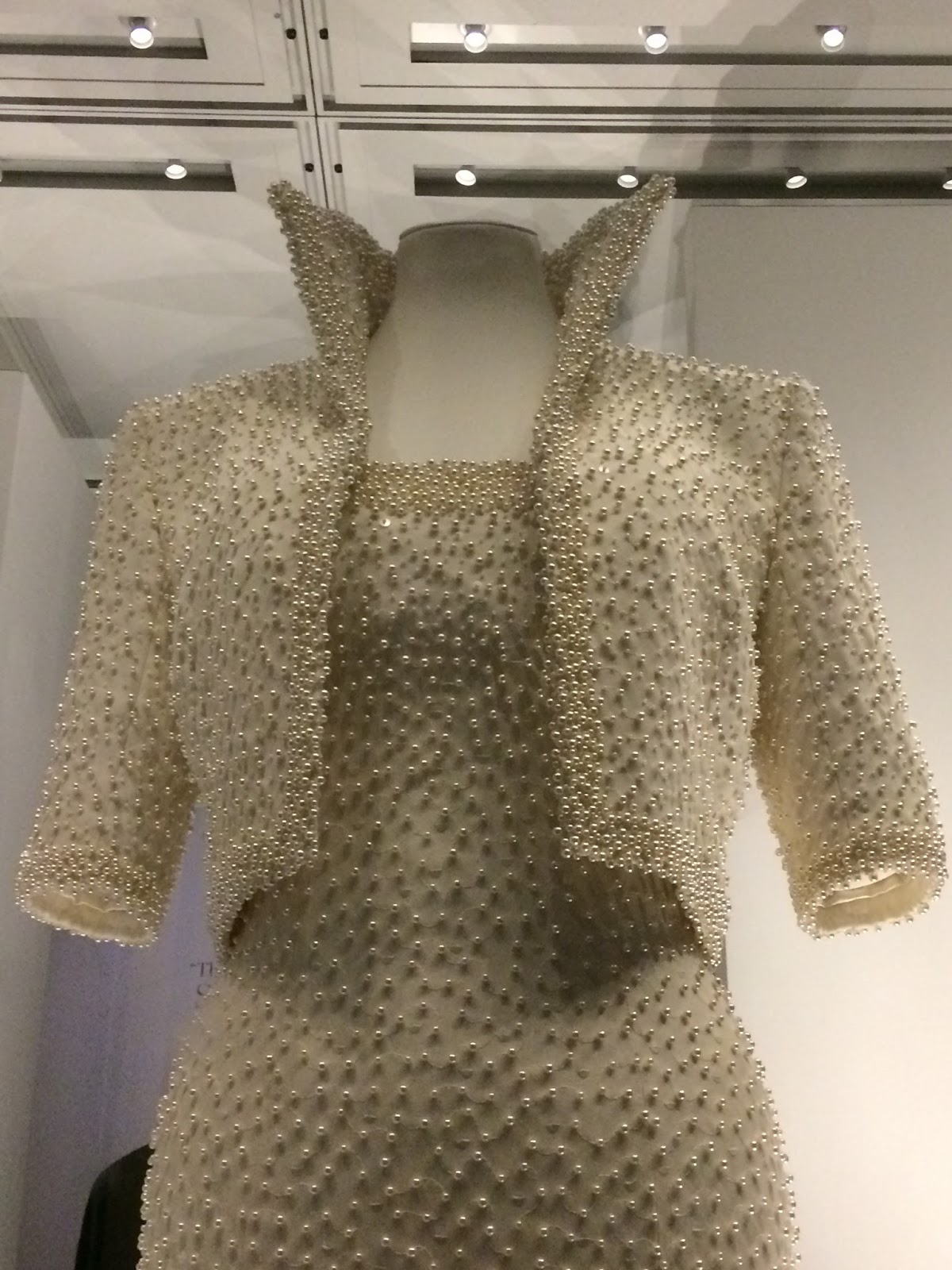
This was displayed clearly in the next room, the main heart of the exhibition; celebrating the height of her influence and admiration through a collection of her most striking and iconic evening dresses worn for state occasions and visits. Apart from anything else, I was in awe of their exquisite finishes and details. Highlights included the white beaded ‘Elvis dress’ the beading is absolutely beautiful so perfectly done. It is also the dress that gives you the best sense of how tall she was as it is displayed on a mannequin with a neck. 

While most were mounted so as the dress appears to stand on its own, hollow of a body but more on that later.  Another favourite was a red silk velvet jacket and dress suit, worn in 1990 and 92’ the jacket features eye catching beading of roses on the tailcoat and sleeves. Similarly to the flamenco dress I loved the uniqueness in the design. The iconic Travolta dress was unfortunately a little hard to see in detail due to the low levels of lighting in the gallery however the elegant style of the design is not diminished. My last standout piece was an ivory silk dress designed by Catherine Walker worn on a visit to Saudi Arabia. The silk crepe dress was embellished with beaded falcons, the national symbol of the country. The beading was so exquisite, a work of pure craftsmanship and the design reflective of the Princesses care to honour host nations in her dress. It is these dresses that feel most personal, in many ways they don’t follow the trends of fashion at the time they are a much more personal visual dialogue, created for specific occasions and to project very nuanced characteristics of the Princess.  In some ways they do reflect aesthetics of 80’s and 90’s fashions but they also feel quite timeless. 
Silk Velvet Embroidered Tailcoat Suit (1990/92')
 
Saudia Arabia Dress
Beaded Falcons Detailing

In the same room as the gowns was a small square cabinet showcasing three outfits she wore as day wear. One of these was the only piece in the exhibition not worn for official engagements, but for a trip to the shops. The other two suits from day engagements. They helped to communicate the more informal Diana and illustrated her role as a working royal, keen to bring attention to often controversial causes as illustrated in the short film playing on the projection screen in front of the cabinet. These outfits reflected how her style choices have shaped the modern monarchy’s approach to dressing for the public; from not wearing gloves, and hats when meeting children to her smart but plain suit choices, projecting an image of approachability not seen before. 


Smart but Approachable

It is clear Diana worked closely with designers and had a lot of input in her outfit’s designs. This was illustrated by the notes she made on design sketches of various outfit designs by designers such as Bellville Sassoon and Roland Klein. However I also found them inspirational from an illustration perspective, with the quite minimalist use of colour and line used to create shape, light and shade of fabric. I also loved how these elements created a sense of movement to the clothes.
Roland Klein
Bellville Sassoon
The final room showcases the dresses worn in the photographs from the famous Mario Testino photoshoot, taken after Diana’s’ divorce from the Prince of Wales. The room has a very different visual language to the others, it is much brighter and the central cylindrical case, soft lighting and subtle colours of the dresses created a calming sense of serenity. The diamante buttons and beads twinkled as her glowing face shone out from the photographs behind, communicating her newfound freedom and happiness.  The dresses in this room showcased a Diana crafting a new identity from her past through the colours and cut of her clothes. With the more neutral colour palette, lower cut necklines and sleeveless styles of all five dresses they projected the image of a woman embracing a new chapter in life.
In contrast, the dresses felt quite ghostlike in the way they were displayed; as if floating in the air creating Diana’s feminine tall elegant frame.  I found myself marvelling at the beautiful clothes, the exquisite construction but also feeling melancholy, knowing they are missing the person that wore them with so much personality and purpose. This was particularly felt in the final room where the dresses are all sleeveless; the lack of arms particularly enforces the lack of person to bring them to life. Coupled with their context in her life, as symbols of her new freedom, they are tainted with sadness, knowing we never got to see how this new chapter and new look would have developed. 
A display of her perhaps her most iconic dresses from the Mario Testino photoshoot
The diamante buttons twinkled in the soft light of the final room
Beading Detail of one of her dresses
A Diana Refashioned and Reborn
The exhibition is many things: it is a showcase of couture design and modern historical fashion but is more than this; it is also a personal story of one woman’s growth and maturity in the public eye from a shy girl to a confidant impactful royal.  In my view Diana’s clothes are more than fashion; they are more akin to costume design; as although they reflect fashions of the time they were designed for her, to make nuanced statements about her character, beliefs, presence.  This is the embodiment of costume design.  Catherine Walker described her clothes for Diana as her ‘royal uniform’ and Jasper Conran described Walkers relationship with Diana as a designer ‘who would concentrate on her’. This is evident in Walkers designs that flattered her tall frame well and emphasized her warmth, diplomacy and compassion through her designs. Her clothes tell of both a unique time in British fashion and the woman who wore them.
A truly fascinating exhibition that gives a very personal insight into the late Princess, with a gorgeous display of her dresses, constructed to the highest standard. The workmanship is incredible; from the beading to the pleating and hand finishes the exhibition displays a dazzling range of couture craftsmanship. It is also a great insight into high fashion of the 1980’s and 90’s. Well worth a visit!

References
Diana – Her Fashion Story., Kensington Palace 2017, Curator Deidre Murphy


Tuesday, 27 September 2016

Adaptations and Recreations – 50 Years of Costume Design for Television Drama A Study Day at the V&A


On the 10th of September I attended the above titled event at the V&A. The day was split up into a series of talks/interviews given by various costume designers and makers. Who have worked on seminal productions; that Cosprop had provided most or all of the costumes for.
All the talks were very insightful on many levels, from how different designers work, to how changing needs in the industry have changed the way costumes are produced. Therefore today I am going to share some of my highlights from the day.


Cosprop is a costume house specialising in period authentic costume which can be hired for theatre, film and TV. The day was kick started with a talk given by Cosprop founder John Bright and Oscar/ Bafta winning designer Jenny Beaven who in the early years of Cosprop often co- designed with Bright on many of the Merchant Ivory films and they continue the partnership today. The talk was chaired and introduced by Theatre and Performance curator at the V&A Keith Lodwick.

Firstly Bright and Beaven talked about the process they used in their early films such as A Room with
a View and Howards End. In most cases designs weren’t produced; mood boards would be created to communicate their vision for the look of the whole film and then individual character boards would be produced for each character. When it came to producing the costumes Bright and Beaven explained how the industry expectations and methods of working were very different from today.

Bright explained how often in their earlier films original fabrics from say the Victorian period were used within costumes, an example was on display at the talk of Vanessa Redgrave’s Howards End costume using original Victorian velvet. Bright expressed how today this would not be possible because in most cases two or sometimes even three and four copies of a costume have to be made so period fabrics can’t be used. Furthermore the methods to create some fabrics aren’t permitted due to health and safety today. Therefore as Jenny Beaven said nowadays people have to buy modern fabrics that look period.

I was also lucky enough to find out what inspires these two wonderful visionaries and which is their favourite costumes that they have designed. Beaven said she differed from film to film with inspiration where as Bright often draws from John Singer Sargent and Giovanni Boldini paintings. Beaven’s favourite costume was perhaps slightly surprising choosing Immortan Joe from 2015’s Mad Max Fury Road as she said ‘it was so different from anything she normally does’ while Bright picked a dress from Merchant Ivory film The Golden Bowl.
Back of Elizabeths Dress, Pride and Prejudice

The second talk focussed on the costumes in Persuasion (1995) and Pride and Prejudice (1995) with designers Alexandra Byrne and Dinah Collin. They explained how the first stage was to prepare mood boards and how much of the historical research was done at Winchester, Bath and Whitworth costume museums. The also stressed the importance of researching and using the right underwear as part of a costume to create the right silhouette or construct.
A dress from each film was on display and they discussed some of the features of these garments.

These included now cord had been put into the armholes and back seam of Elizabeth’s muslin dress in Pride and Prejudice, because it was such a fine fabric. Illustrating how period costume has to sometimes be adapted to withstand modern filmmaking.
An interesting fact, the yellow jacket in Persuasion was in fact made of millinery velvet. You can see details of the costume below.
Details of Costume from Persuasion
One of the most useful and interesting facts I gleaned from this talk, was that often designers send colour swatches of all the fabrics used in the costumes to the post production department to ensure fabric colours aren’t distorted in the final edit.

After lunch the third talk digressed from the main focus on the day (Cosprop). This time looking at The Six Wives of Henry VIII (1970), designed by John Bloomfield. Where the previous talks showed what could be done with a fair amount of investment, Bloomfield discussed now he produced the costumes for the six part series on a tiny budget. He explained how a lot of the costumes were very rudimentary by today’s standards using old parts of jewellery glue gunned on card to make embellishments and using cheap upholstery fabric, it also evidenced how much technology has moved on since then and how these techniques just wouldn’t work today due to high definition TV.

The Dowager Countess Dress worn by Maggie Smith
The last talk focussed on the critically acclaimed period drama Downton Abbey looking at both the design and production of this seminal drama. The talk featured series 1 and 2 designer Susannah Buxton and series 3 designer Caroline McCall who was assistant designer on series 1 also. There were also three makers, Donna Simmons a Tailor, and Thais Demontrond and Caroline Green who were Women’s Makers.

They talked about a whole range of points from how different colour schemes were decided for each of the Crawley sisters (reds for Mary, greens for Edith and blues for Sybil) to the search for the right servants cap for the house maids in series 1. The aprons and dresses were actually modelled on originals from the Cosprop archive.

They also explained that because there was such a large amount of costumes needed for the series, many of the costumes were commissioned to be made by Cosprop. This also happened for special props that were needed such as the ‘family tiara’ worn by Lady Mary/ Edith, which was copied from a Cartier but made using less precious stones.

One particularly interesting anecdote explained how an original 1920’s dress that was damaged in the centre back and front was reassembled with the fronts used as sides and sides used as front and backs.

Detail from Dowager Countess Dress
The day ended with a brief presentation about the new John Bright Costume Collection Database which is being launched soon. Over the past year volunteers have been assisting in photographing and mounting costumes from John Bright’s collection of historical dress to be uploaded to an online research database. As the database will be up and running in the next few months I look forward to using it as part of my design research in my next term at university. The only disappointing thing was that I hadn’t heard about it sooner because I would have loved to have helped with the preparation!

Well that concludes my review of the Adaptations and Recreations study day at the V&A. It has defiantly left me with a lot to think about and take in as well as inspired me to keep following my dreams in the world of costume design. I’d like to leave you with this last quote said by Rosemarie Fernandez Day: “John Bright bought attention to real clothes” I don’t know about you but I defiantly agree. Its clear Cosprop and John Bright’s passion for authenticity has had fundamental influence on the way we all perceive period drama and will do for years to come.
 Images of Lady Cora's Dress from Downton Abbey


Monday, 26 September 2016

Seven Cultural Hotspot Highlights of East Sussex to Visit!

From the 9th -19th of September this year I went on a lovely holiday to East Sussex with my family. We visited some wonderful stately homes and several good museums. Therefore I thought I’d share with you some of my highlights from the trip that I recommend to visit if you’re passionate about history, art, fashion or design. 


One of the first places we visited was called Farley Farm; this was the home of the model and war photographer Lee Miller and her artist husband Roland Penrose. The house is uniquely decorated with Roland’s artwork and murals that he painted and many of Miller’s photographs are on display around the house and in the gallery / ticket area.  You are taken around the house on guided tour which was very insightful as you are able to learn about the stories behind many of the artefacts in the house.
Fire Place Harvest Mural
Personally I loved the interior design of the house particularly the fire place mural in the dining area, a surrealist interpretation of the harvest and symbols associated with it. The colours are warm and vibrant definitely a stand out piece.

Dresser at Farley Farm
Detail of Fireplace
As well as the house there is also a garden to walk around which features several abstract sculptures. It’s very picturesque on a lovely sunny day.

Farley farm is similar to another artist’s home in East Sussex, Charleston home of the Bloomsbury artists of the early 20th century. Although the art itself is completely different there is a common feeling of artistic liberation and content living. If you have been to Charleston then you should definitely visit Farley Farm and if you have been to Farley Farm definitely visit Charleston!
More details about Farley Farm can be found here: http://www.farleyfarmhouse.co.uk/
and Charleston can be Found here: http://www.charleston.org.uk/

The next place we visited was a National Trust property called Standen House; Standen is famous for its sumptuous Arts and Crafts interior. William Morris & Co lovers you will be in heaven! From the furniture to the carpets the walls to the upholstery all is rendered in rich romantic gothic patterns of greens, reds, blues and gold. It is simply gorgeous; the few snapshots below don’t do it justice in the slightest.  The property also has lovely grounds to walk around in.
The Living Room at Standen House

The other stand out home we visited was Chartwell in Kent and the home of wartime Prime Minister Winston Churchill unfortunately no photography is allowed in the house or studio so the only images I have to share are copies of some postcards I bought in the shop. It is a really interesting place showcasing a mixture of family, military and wartime history. The standout for me was the room showcasing all Churchill’s uniforms he wore for different engagements. From university dean to various military ones, as a costume student with a passion for millinery I was particularly taken with all the different hats.   However my favourite room was the dining area with the oval windows and elegant furniture it felt like something out of a period film, very stylish indeed.
The Dining room at Chartwell
There is also a small out building at Chartwell which is open to the public, this is Churchill’s Studio, he was an impressive artist and painted regularly. The walls are decorated floor to ceiling with his paintings and part of the room is set up like a work area. I loved the use of colour in his pictures.
Churchills studio
As well as National Trust properties I also visited several museums and galleries not least Bexhill Museum. Set back from the sea front and down from the landmark De la Warr Pavilion the Bexhill Museum houses an impressive collection of historical artefacts, period costume and motor history items. The Costume Gallery was the main attraction for me and I have to say I was very impressed. The gallery is arranged in a timeline going around the outside wall of the room. It tells the story of fashion history in relation to social history and clothing’s role in everyday life; with items ranging from the 1750’s up to the present day. In the centre of the gallery was a temporary exhibition of examining the changing face of the wedding dress. Antique dresses were displayed in cases ranging from Victorian up to the 1930’s and modern pieces, many on loan from their owners displayed on white plinths. As you will see from my photos there was a lot to see, some of which I feel will inspire my current costume work.


Another cultural highlight was the Brighton Museum; again this had an impressive costume collection and exhibition. There permanent collection tells the story of Brighton’s influence on designers who studied in the city as well as showcasing the range of street styles seen over the years. There temporary fashion exhibition was entitled ‘Fashion Cities Africa’ exploring the rise of fashion design in North African countries. The exhibition showcased unusual textures, bold electric uses of colour and hip silhouettes. It also introduced me to an area of fashion I had never really thought about before and now want to learn more about. The work was just so beautifully exotic, definitely worth a visit.  
There is also a large gallery in the museum that tells you all about the history of Brighton, a city with such an unusual vibe and known for its liberal attitude, its unsurprising it has a colourful history. I found this section really interesting, although I knew a bit about Brighton’s past. I defiantly learned a lot from the information and artefacts displayed. Worth a visit if you want to know more about Britain’s most bohemian city.

Another museum highlight was the performance gallery, displaying a collection of props, costumes
and masks communicating the history of carnivals and fancy dress there were some really unusual objects to be seen and all very theatrical.

As we were staying near to Hastings we also visited the Jerwood gallery, a modern art gallery it had on display an exhibition by mixed media artist Marcus Harvey, a collection of self -portraits by various artists and a one room exhibition entitled ‘The Boy who Bit Picasso’ this was by far the most interesting collection on display, not least because it related very well to our visit of Farley Farm. Picasso visited Farley Farm on a number of occasions and was friends with Miller and Penrose. 
The exhibition displayed many photographs taken by Miller of Picasso often with Miller/Penrose’s son Anthony (now owner of Farley Farm). The portraiture collection was also thought provoking, to see now different creatives view themselves.

One of the last places we went to was Scotney Castle, the castle itself is actually a ruin however there is also a stately house on the same sight. The house features striking architecture from the outside and elegant style on the inside and was home to the industrialist Hussey family. The old 14th century castle ruin is set in stunningly picturesque grounds and is the perfect place for a relaxing walk.  

Well that concludes my cultural hotspot highlights of East Sussex if any of the places mentioned appeal to you check them out I assure you, you won’t be disappointed!